
The Bay Long Jump School record progression can be handled with a bare minimum of words.
1934-1936: I have no idea
1937-1964: Paul Klein 22-6-1/2
1965-2024: Paul Priebe 23-4-1/2
Nope, don’t even think about it, you’re not getting off that easy. I’ve got lots of things to say about Paul Klein and Paul Priebe. As well I should, since they’re two of the greatest athletes in Whitefish Bay history.
This is the Long Jump Top 5 through 2024:
23-4-1/2 Paul Priebe 1965
22-6-1/2 Paul Klein 1937
22-0-1/2 Eric Smith 1962
21-9 Jim Coulson 1968
21-8-1/2 Bill Humke 1967
It’s hard to believe that the last jump to make the Top 5 was 56 years ago, but I believe it to be true. It’s definitely true through 1990.
Paul Klein grew up with five siblings at 1135 E. Lexington, the son of a physician. My guess is that he went to Henry Clay, since when St. Monica school opened he would have been entering fourth grade. If he went to Henry Clay he would have been taught 8th grade science by young buck Charlie Roeder.
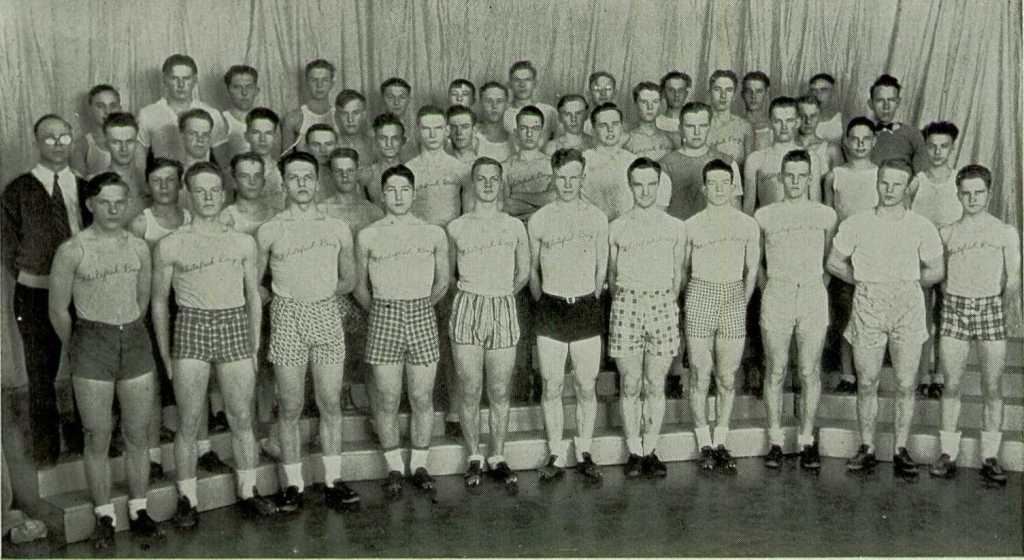
In this photo of the snazzily-attired Bay 1936 track team, Paul Klein is front row, fourth from right. 1938 Classmate Bob McCahill is front row fourth from left.
Paul Klein had been a good athlete through his sophomore year, but was an outstanding one his junior year.
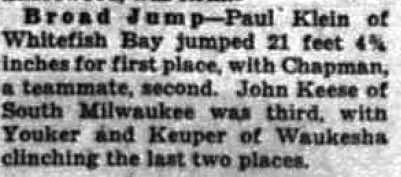
In the early years the Bay was much smaller than most Suburban schools and got knocked around a lot by the much larger schools, especially in football, Shorewood among them. The Bay went 2-4-1 in 1936. But junior Paul Klein was named 1st-Team All-Suburban halfback.
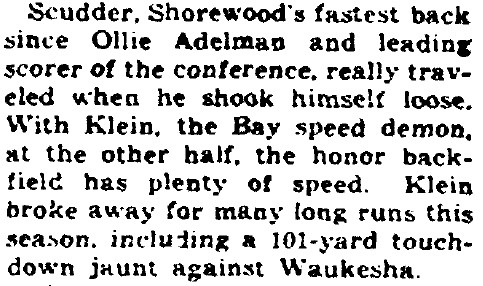
At the 1937 State track meet the Whitefish Bay high school tracksters tipped the dope and ran away with the Class B State title, with Paul Klein setting the Class B State record and tying the overall State record in the Broad Jump with his 22-6-1/2 at Camp Randall. Klein also finished third in the 100 and Low Hurdles
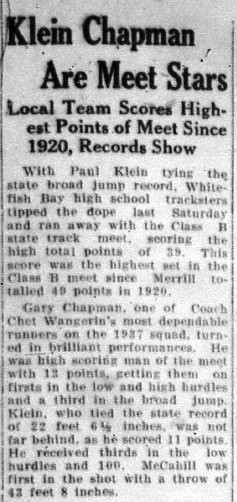
At the Suburban the next week Klein won the Broad Jump and again added thirds in the 100 and Low Hurdles.
The Bay opened the 1937 football season with high hopes.
In the first game ever played on the new Bay football field the Bay beat Milwaukee Rufus King 13-7 behind touchdowns from Bob McCahill and Paul Klein. But they suffered a catastrophic loss.

Victim of a cheap shot.
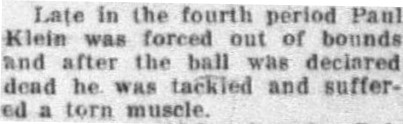
To my knowledge, Paul Klein played in exactly one play the rest of the football season. But it was a big one.

Shorewood struck first, but missed the extra point. On the ensuing kickoff the Bay pulled a razzle-dazzle and hit paydirt.
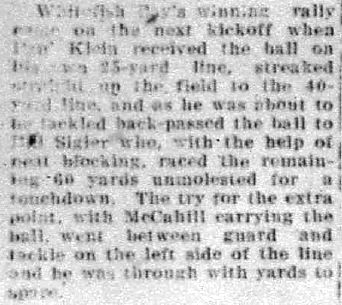
I know it’s hard to read. My interpretation is that Klein fielded the kickoff as a decoy, went as far as he could while drawing the gullible Greyhounds with him and before being tackled lateraled to junior Bill Sigler, who then took it to the house. Sigler was yet another great Bay athlete of the 1930s — 1st Team All-Suburban in football as a senior and won a State title in the Shot Put.
Bob McCahill converted the extra point on a line buck to give the Bay the lead and the Glory Cup.
Klein didn’t compete in his senior track season in 1938, presumably due to the football injury.
About 5 minutes of online research revealed the following about Paul’s life:
He went to college for at least two years, was working at Blatz early in WWII and was in the Army from August, 1942 through October, 1943. His enlistment record lists him as 5’7″ and 144 lbs. He got married in 1948 and per the 1950 Census was a leather goods salesman living in an apartment on Capitol Dr. in Shorewood with his wife and infant daughter. The family later lived at 6241 N. Lake Dr. in the Bay.
Paul passed away in 1994 at age 73.
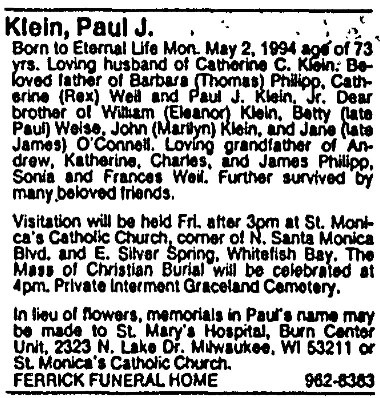
I don’t know where Klein’s daughters went to high school, but I believe his son went to the Bay.
Paul Priebe, where to even start.
He went to Richards and grew up living at 5961 Bay Ridge. And it appears he had to have had some diving training at a young age.
I know nothing about swimming/diving, so I’m just being Joe Friday here.
As a freshman at the Bay Paul finished finished fourth in diving at the Suburban.
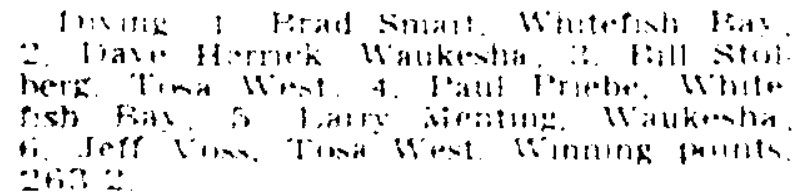
He didn’t qualify for State.
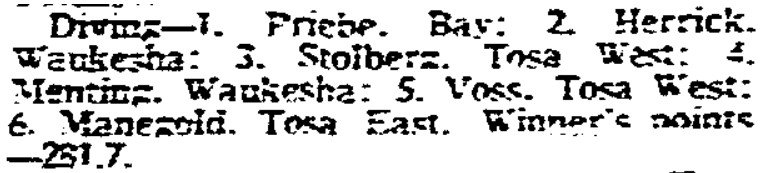
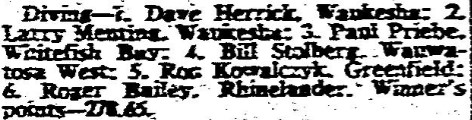
As a sophomore Paul won the Suburban, but finished third at State behind two veteran Suburban guys he had just beaten.
1963 Suburban:
1963 State:
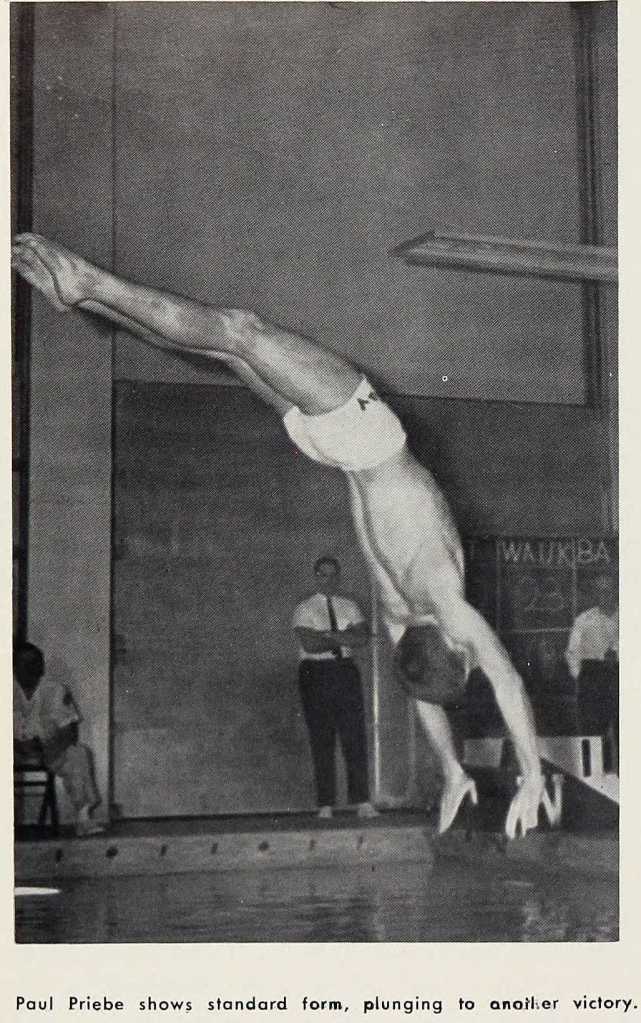
Picture from 1963.
From then on Paul had a clean card at both the Suburban and State.
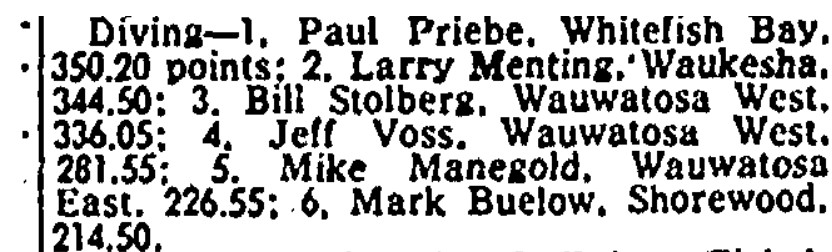
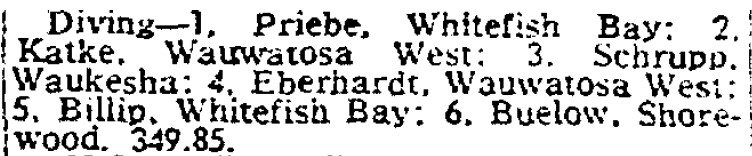
1964 Suburban:
1964 State:
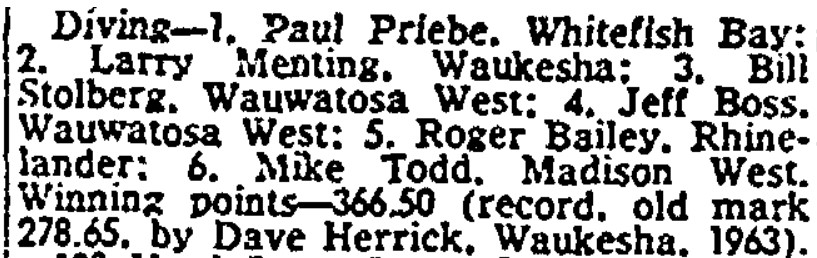
It’s interesting that for two years Priebe was basically competing against the same older guys at Suburban and State. My hope is that Larry Menting, Bill Stolberg and Jeff Voss have spent much time over the last 60 years cursing out that bad, bad boy from Whitefish Bay — Paul Priebe.
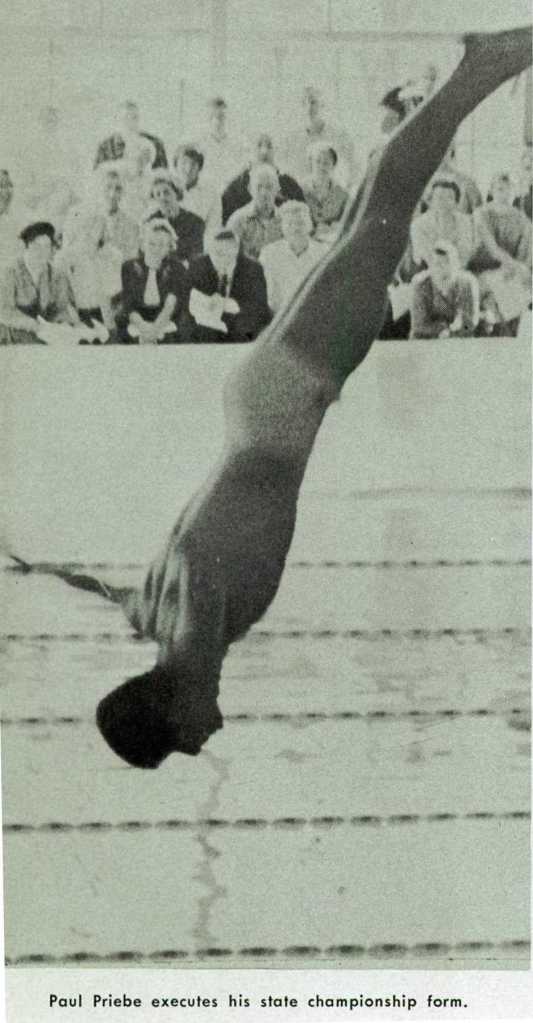
Picture from 1964.
1965 Suburban:
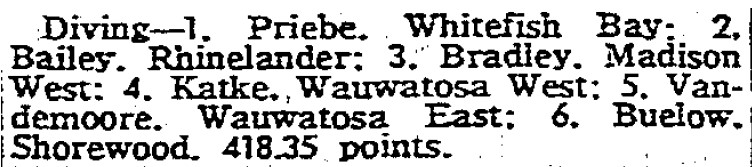
1965 State:
The first pool at the Bay opened in the fall of 1949. I’m curious how Coach Morgan Byers divided things up between swimmers and divers after he became the swimming coach in the 1950s. Somebody had to be there practicing every morning from 6:30-7:45 AM, right? No separate area for divers in those days.
So to summarize, Paul Priebe placed at Suburban all four years, winning three titles, and had three places at State, winning two State titles.
Seems like a reasonably good diving career to me.
I don’t know what Paul Priebe did in track as a freshman. But as a sophomore he was very good.
He didn’t place in the Suburban Indoor in the Broad Jump, but jumped very well the rest of the 1963 season.
2nd at the Suburban Relays:
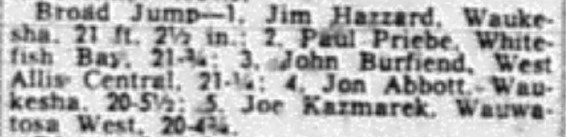
3rd at the Sectionals, a place out of qualifying for State. There were no extra qualifiers in those days.
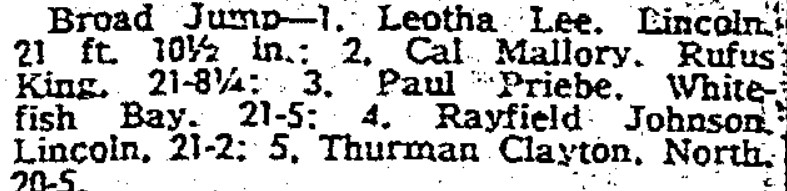
5th at the Suburban Outdoor:
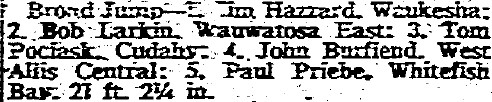
So that’s 21-5 as a sophomore. And this is just what I know of. That’s an elite mark in general and crazy good for a sophomore. And 60 years later any high school kid jumping over 21 feet is superb.
1964 Indoor:
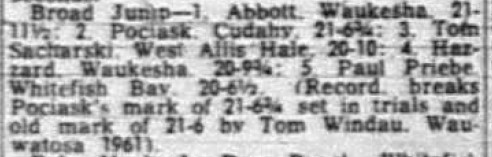
The Bay Fieldhouse opened in 1969. So where did Long Jumpers have an indoor pit to practice jumping in 1964? Hell if I know.
I’ve sort of addressed this before.
https://baystrackhistory.blog/2018/04/26/potw-1948/
1964 Suburban Relays:

21-8 was likely a PR.
The Bay won a tight one at the 1964 Suburban Outdoor. 39-34 over both Waukesha and Wauwatosa West. This was the 14 event 5-4-3-2-1 era with only two running events allowed and only three events total.
Paul Priebe scored six points individually and likely ran on the third place 880 Relay team that sealed the win.
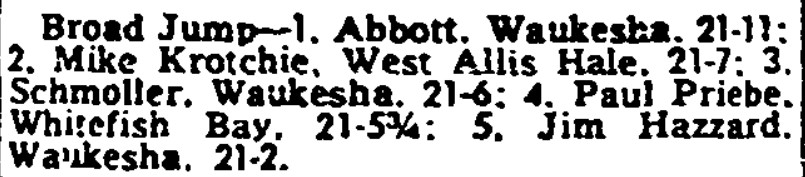
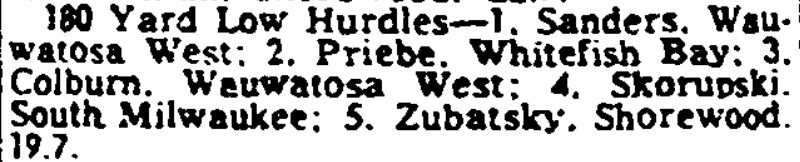

That’s the first major meet I’m aware of where Paul ran an individual 180 Low Hurdles.
I’ve mentioned Art Sanders of Wauwatosa West before.
The 1964 Sectional meet held at the Bay single-handedly caused a massive WIAA rule change that exists to this day.
At the State Meet at Monona Grove the next week, the Bay sectional accounted for seven wins, three seconds, and a stunning 61 1/2 points. This is from a total of 210 points and the maximum possible for a sectional to score was 126 (first and second in every event). 16 of the 28 qualifiers placed. Five teams from the Bay Sectional placed in the top ten.
That summer the WIAA Board appointed a special committee (bypassing the Rules Advisory Committee, which might have opined on the issue sometime between Monterey and Woodstock) to look at the issue of extra qualifiers. The special committee recommended that any mark in the top six including ties of all sectional performances qualify for state. The Board approved top five and ties and the rule was in place for 1965.
Back to the 1964 Bay Sectional.
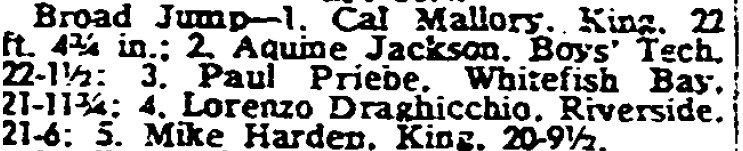

So Priebe didn’t qualify in the Broad Jump, but did in the 180 Lows. The 21-11-3/4 was the 5th best sectional jump and would have qualified for State under rules in place ever since. Another sectional was held at Nicolet on the same day, just a mile from the Bay. 19-7 and 19-6 qualified. I have no words.
We’ll never know what would have happened at State if Priebe had qualified. Jon Abbott from Waukesha finished second. Scrolling back up you’ll see that Priebe had several scalps over Abbott in Suburban competitions, while the reverse was true as well. Madison Central junior Larry Franklin won in 23-6, just an inch short of the 23-7 1944 State record of Shorewood’s Ralph Welton.
The State 180 Lows went well:
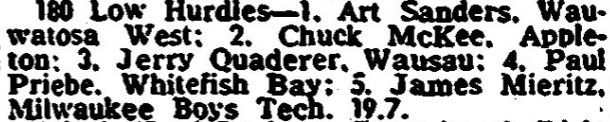
The Bay went into the 1964 State Meet as one of the favorites, but other than John Seefeld in the throws and Priebe placing in the 180 Lows, nothing went well. The Bay finished T6 with 11 points, not that far off from the title. Madison West won with 15, with Wauwatosa West (Art Sanders actually) and Waukesha with 14. The only good thing I can think of is that Waukesha had to have been pissed off with the result.
Priebe had a good 1965 Suburban Indoor meet.
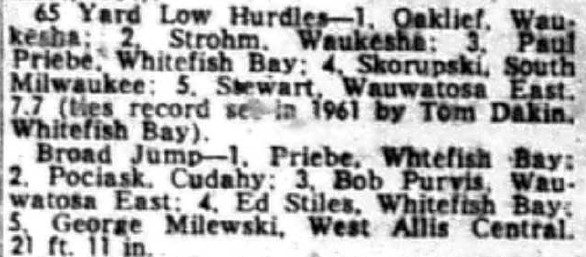
The 21-11 in the Broad Jump was half an inch short of the Suburban Indoor record and was beaten just twice in the rest of the Suburban Indoor era, and just barely at that. And I still want to know where the Bay had a jumping pit to practice.
The Bay doubled up every team in winning the Suburban Relays. Priebe won the Broad Jump and likely ran on the 440 and 540 Low Hurdles relay teams that finished second.

The 22-1-1/2 was the second best jump in Suburban Relays history. The great Ralph Welton of Shorewood went 23-0 in 1944. And the 63-10 from the relay team (Paul Priebe, Ed Styles, Jim Zien) was still the Bay school record in 1990 and I can’t imagine it having been close to broken since.
The Bay won a close, nail-biting title at the 1965 Suburban Outdoor at Hart Park in Wauwatosa.

Key to the win was the Bay getting one of the best performances in Suburban track and field history from Paul Priebe. And it took a record-tying effort in the 100 from one of the best Suburban sprinters of all-time to keep it from being a Suburban Triple.

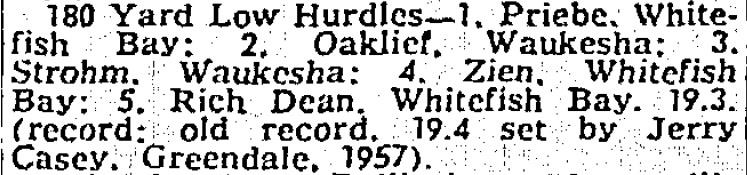
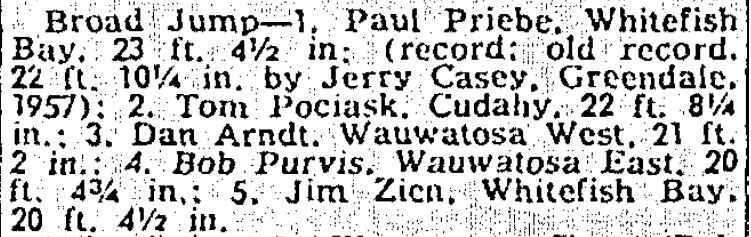
In that or any era, Suburban Outdoor records weren’t broken all that often. And Paul Priebe did it twice in one meet. And those two records had been held by the great Jerry Casey of Greendale.
I don’t know how to describe how ridiculous that performance was. What can be said?
The 23-4-1/2 Suburban record was never broken. 22-5 was the next best mark after 1965.
Priebe easily qualified for the State Meet in the Broad Jump and 180 Low Hurdles.
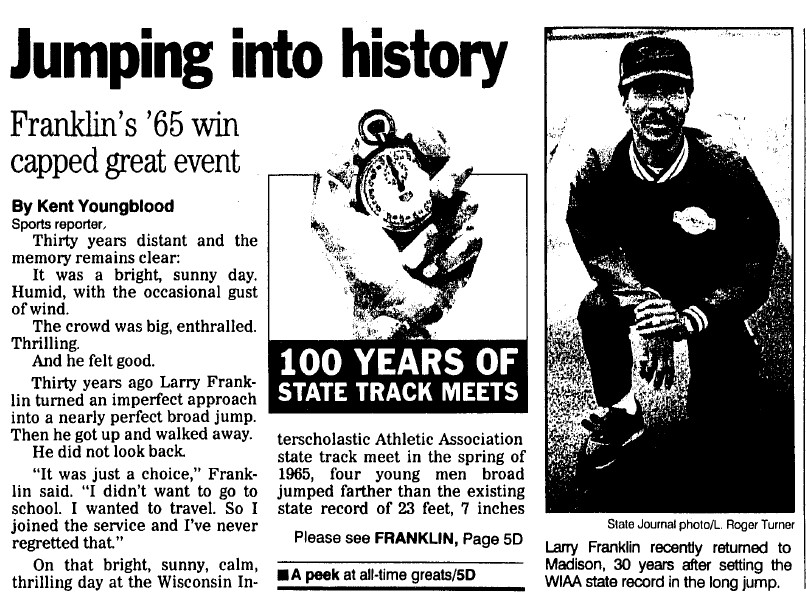
There was a ton of buzz going into the 1965 State Meet about the Broad Jump. The discussion wasn’t about whether the State record of 23-7 set by Ralph Welton of Shorewood in 1944 would go down, it was about by how much and how many guys would beat it.
The answers were “by a lot” and “four”. Unfortunately, Paul Priebe wasn’t among the four. He jumped “just” 23-4.

It wasn’t until 1990 that a jump greater than 23-4 won the Class A/D1 State title. And 23-4 would also have won in many years after 1990. It’s an incredibly elite mark.
In 1995 the Wisconsin State Journal in Madison had a six-part series celebrating the 100th anniversary of WIAA track and field. One of the six parts was solely dedicated to the 1965 Broad Jump.
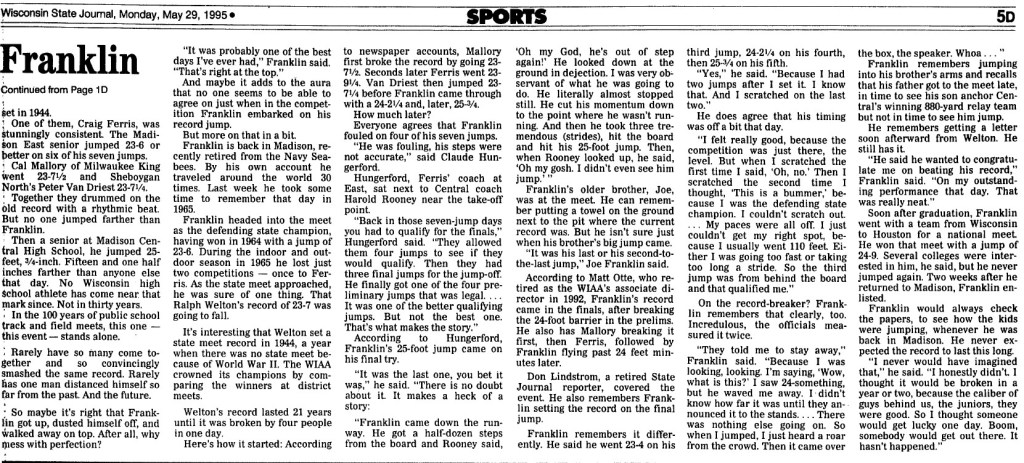
The 180 Low Hurdles trials went well. Priebe had the fastest time, tying the State record with a 19.6. His reward was to be given by far the worst lane for the finals — lane 1.
I was at the 1965 State Meet and this is my memory of the final, later more or less corroborated by several adults.
Paul came out of the turn in third or fourth, was tied for the lead by the sixth hurdle and was moving with a bullet. He hit that sixth hurdle and fell.
It’s the greatest individual tragedy in Whitefish Bay track and field history. Nothing else is close.

My theory 60 years later is that with the disadvantage of lane 1 and the juice of the moment, he was running faster than he ever had to catch up and simply got too close to the hurdle. It only takes a couple of inches.
Paul took about 15 seconds to gather himself and then walked down to the finish area to shake hands with the champion and other finishers.
That’s the exact behavior you’d expect from one of the best athletes in Whitefish Bay history — and it came during what had to be the worst 30 seconds of his life.
The winner set the State record at 19.3 from lane 5 where the curve is much, much easier to navigate. Call me a sore loser or an asshole — either description fits most of the time — for being especially grateful when Howie Zien ran 19.1 to set the State record the next year.
All volumes of The Tower had descriptions of the graduates through 1965. That was the last year.
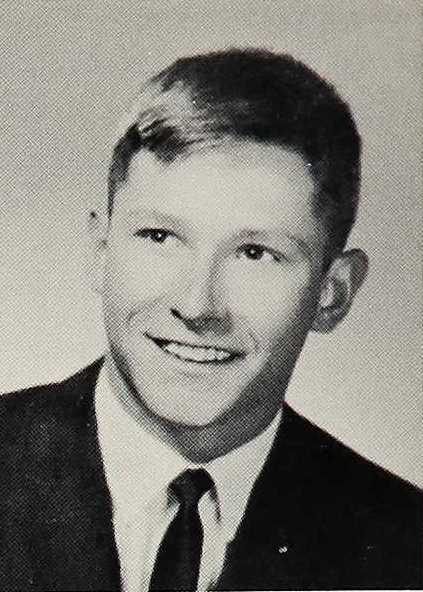
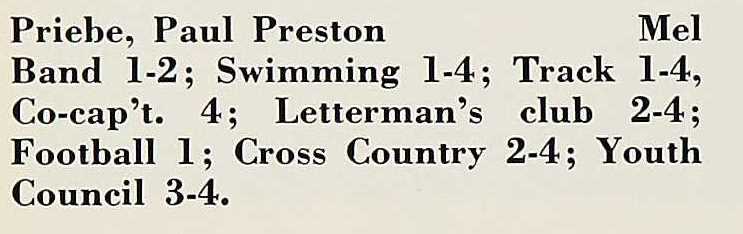
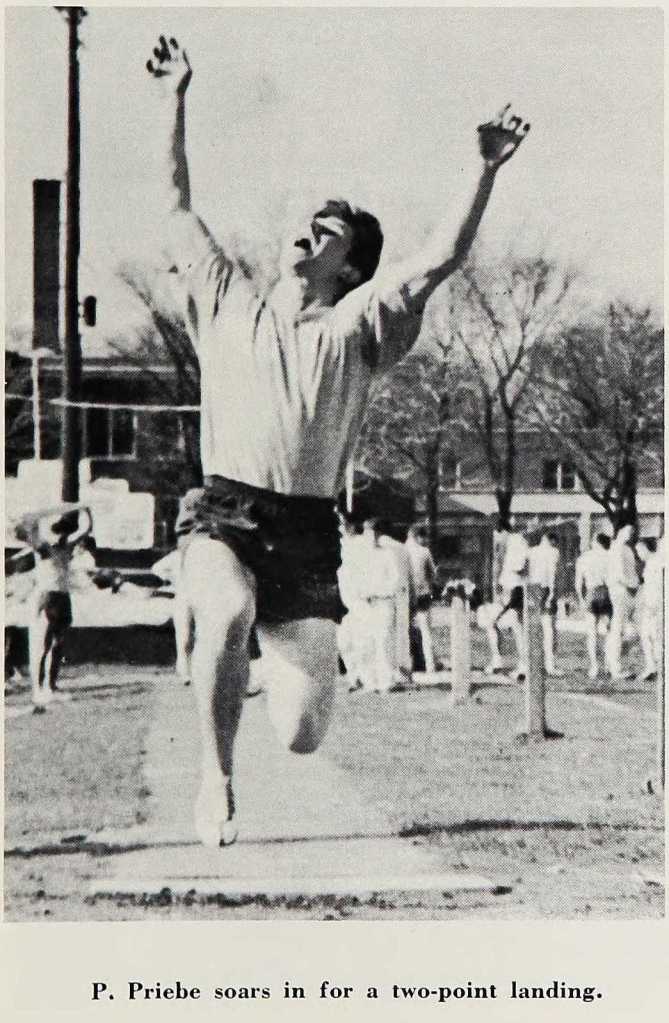
Paul obviously clowned for the camera and it was actually used in the 1965 Tower.
I’ve never heard of the Unico organization, but they made some wise choices for their awards in the summer of 1965.
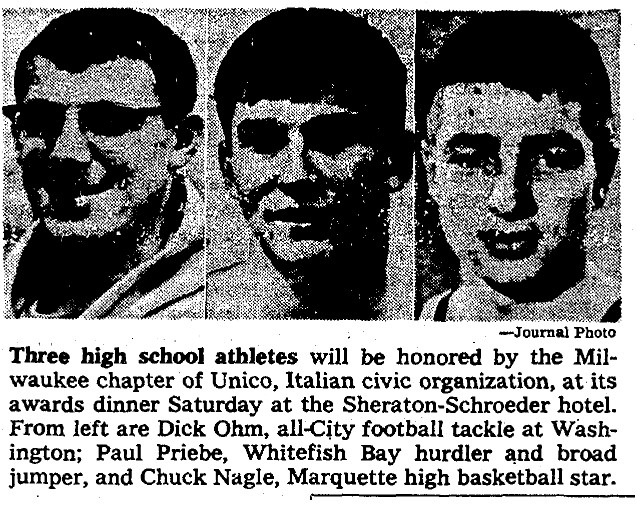
No mention of the diving for Priebe.
Chuck Nagle went on to have a great basketball career at Wisconsin and, obviously, is the son of Jack Nagle, the long-time boys and girls basketball coach at Whitefish Bay. In an incredible move, Jack had resigned as the head basketball coach at Marquette University after the 1958 season and accepted a job as a freshmen English teacher and JV basketball coach at the Bay. He became the head boys coach at the Bay for the 61-62 season and girls for the 73-74 season. I’ve heard nothing but praise for Nagle as a teacher.
Agreeing to take the girls position only because nobody else wanted to do it ended up re-igniting Jack’s passion for coaching basketball. It was an amazing thing to see. He learned early on that he couldn’t instinctively pat a player on the butt going into or out of the game.
Interestingly, Jack and Winnie Nagle sent their three sons to Marquette High School rather than having them walk 10 minutes to Shorewood. And Jack had been a basketball star at Shorewood in the 1930’s, earning the nickname “Swish”.
Where were we? Oh yeah. Paul Priebe.
Priebe went to Yale, graduating in 1969. He competed in diving as a freshman, but I don’t know if he competed in athletics after that.
He graduated from the Medical College of Wisconsin in 1973, went to Case Western Reserve University Hospital in Cleveland as an intern, then resident and never left Cleveland. Then, as now, Case is a sneaky top 50 university in the country.
He became a Gastrointestinal Surgeon, a teaching surgeon on the Case Medical School faculty and Hospital and was affiliated with various medical systems over the years. He retired in 2019 and remains on the Case faculty.
This is an interview from 2019.
 Whitefish Bay Track and Field History
One thought on “The Bay Long Jump School Record Progression”